Course Design:
Understanding Art
Redesign Spring 2022
Understanding Art is a freshman or sophomore humanities transfer-credit. Some universities call this Art Appreciation. Students typically enroll in this course for:
non-major taking a humanities credit, or
major or non-major interested in pursuing art as a degree.
This course has run as an online course, a hybrid course, and a face-to-face course and uses a textbook by Cengage that integrates well with Canvas.
Art 2101 Outcomes and Objectives
The information in this section highlights the Course Learning Outcomes and Student Learning Objectives for Understanding Art.
These outcomes are referenced in the assessment process.
Course Learning Outcomes
A written statement that reflects what the learner will be able to do as a result of participating in the course/ education. (Essential Questions)
Theorize why art is created and determine how
to perceive and evaluate visual art.
Analyze how the elements and principles of art
& design are used in the creation of artworks.
Recognize traditional and innovative media
uses by artists across art forms.
Student Learning Objectives
Statements that define the expected goal(s) of an educational course/ activity. “I can” statements. (Knowledge & Skills)
By the end of this course students should be able to…
List the major disciplines of visual art.
Define the vocabulary of visual art.
Classify specific works as assigned
Compare styles of art through writing as assigned.
Create original artwork to explore various art media.
Major Assessments (online)
The “Major Assessments of Understanding Art” accordion highlights both the assessments and general layout of the course. Each module is broken down into 4 categories:
Module Outcomes,
Assessments,
Type of Assessments and Module Learning Outcomes,
and Student Learning Outcomes addressed in the Module.
Within the course itself, I provide a variety of approaches to assessment, including free response questions, performance tasks with rubrics, multiple choice and short answer quizzes, sketchbook assignments, art projects, and a research paper. At this point in the Instructional Design process, I am trying to determine:
what the general layout of the course looks like in terms of structure, and
(what types of AUTHENTIC assessments assist the learner to answer the essential questions of the course and reinforce the student learning outcomes.
Please note: I have included a variety of example modules from the redesign - There are 13 modules in the published version of the course. For additional module content, please ask for examples.
-
Module Outcomes:
Converse with classmates and faculty.
Identify topics covered in the course and course expectations.
Assessments
Discussion Board #1 – Self Introduction Video
Quiz #1 – Syllabus Quiz
Type of Assessment(s) & MLO’s
Free Response Question - 1
Multiple Choice Quiz- 2
SLO’s addressed in Module
N/A (introduction)
-
Module Outcomes:
Illustrate and sketch compositions and utilize materials as form of expression.
Create rough-drafts and brainstorm
Assessments
(Sketchbook Assignments correspond to modules are paired with each topic, but will be listed in this module)
Type of Assessment(s) & MLO’s
Performance Task w/ Rubric - 1, 2
SLO’s addressed in Module
4, 5
-
Module Outcomes:
Describe the subject, form, content, and style of artwork using appropriate terminology.
List visual elements and design principles that create artistic form.
Define specific terms for types of artistic styles.
Assessments
Discussion Board #2 – Post a video of something you consider art.
Opinion Paper #1 – What is Art?
Quiz #2 – Chapter 1 (m/c)
Sketchbook Assignment #1
Type of Assessment(s) & MLO’s
Reflection Prompt- 3
Inquiry-oriented Paper- 1, 3
Multiple Choice Quiz- 2, 3
Performance Task w/ Rubric - 2
SLO’s addressed in Module
1, 2, 3, 4
-
Module Outcomes:
Identify the effects and functions of lines in art.
Describe the types of shapes in both two-dimensional and three-dimensional works of art.
Assessments
Discussion Board #3 –
Quiz #3 – Writing About Art (Short Answer)
Sketchbook Assignment #2 (Scavenger Hunt for Line and Shape)
Type of Assessment(s) & MLO’s
Reflection Prompt- 1, 2
Written Response Quiz- 1, 2
Performance Task w/ Rubric - 1
SLO’s addressed in Module
2, 4, 5
-
Module Outcomes:
Describe different types of texture within artworks.
Interpret the significance of textural choices in particular works of art.
Explain the concept of pattern and identify its use.
Assessments
Discussion Board #5
Quiz #5 – Chapter 4 (compare & contrast)
Project #1 – Tiktok/ Video
Type of Assessment(s) & MLO’s
Reflection Prompt- 1, 2
Written Response Quiz- 1, 2, 3
Performance Task w/ Rubric - 1, 3
SLO’s addressed in Module
2, 3, 4, 5
-
Module Outcomes:
Recognize the major differences in sculptural techniques and materials in three-dimensional media.
Explain the major categories of works of art that are site-specific.
Justify the definition of sculpture as it relates to contemporary methods and materials.
Assessments
Project #3 – Plaster Masks
Project Checkpoint #1 – Topic of Final Project or Presentation
Quiz #9 – compare & contrast
Type of Assessment(s) & MLO’s
Performance Task w/ Rubric - 1, 3
See Research Paper MLO’s
Written Response Quiz – 1, 3
SLO’s addressed in Module
1, 2, 3, 4, 5
-
Module Outcomes:
Explain the features of the four basic categories of printmaking.
List ways that the processes of print creation are different than other two-dimensional media.
Describe how technology has influenced contemporary printmaking.
Assessments
Project #4 – Printmaking &
Graphic Design
Project Checkpoint #2 – List of Artworks
Quiz #10 – Ch. 9 MC
Sketchbook #6
Type of Assessment(s) & MLO’s
Performance Task w/ Rubric - 2, 3
See Research Paper MLO’s
Multiple Choice Quiz – 1, 2
Performance Task w/ Rubric – 1, 2
SLO’s addressed in Module
1, 2, 3, 4, 5
-
Module Outcomes:
Research the biography of a contemporary artist.
Discuss techniques and styles of artworks by the artist.
Analyze how the artwork created reflects the culture which produced it.
Compare and contrast the visual characteristics and contextual information of artworks created.
Assessments
Research Project #1: Rough Draft
Research Project #2: Final Paper or Presentation
Discussion Board #10– Final!
Type of Assessment(s) & MLO’s
Research Paper – 1, 2, 3,4
Research Paper – 1, 2, 3, 4
Reflection Prompt – 2, 3, 4
SLO’s addressed in Module
2, 3, 4
Examples of Learning Materials & Assessments

The visuals of a course are an important part of designing a course, and so I design banners for major categories of assignments such as the homepage, discussion boards, assignments, etc.
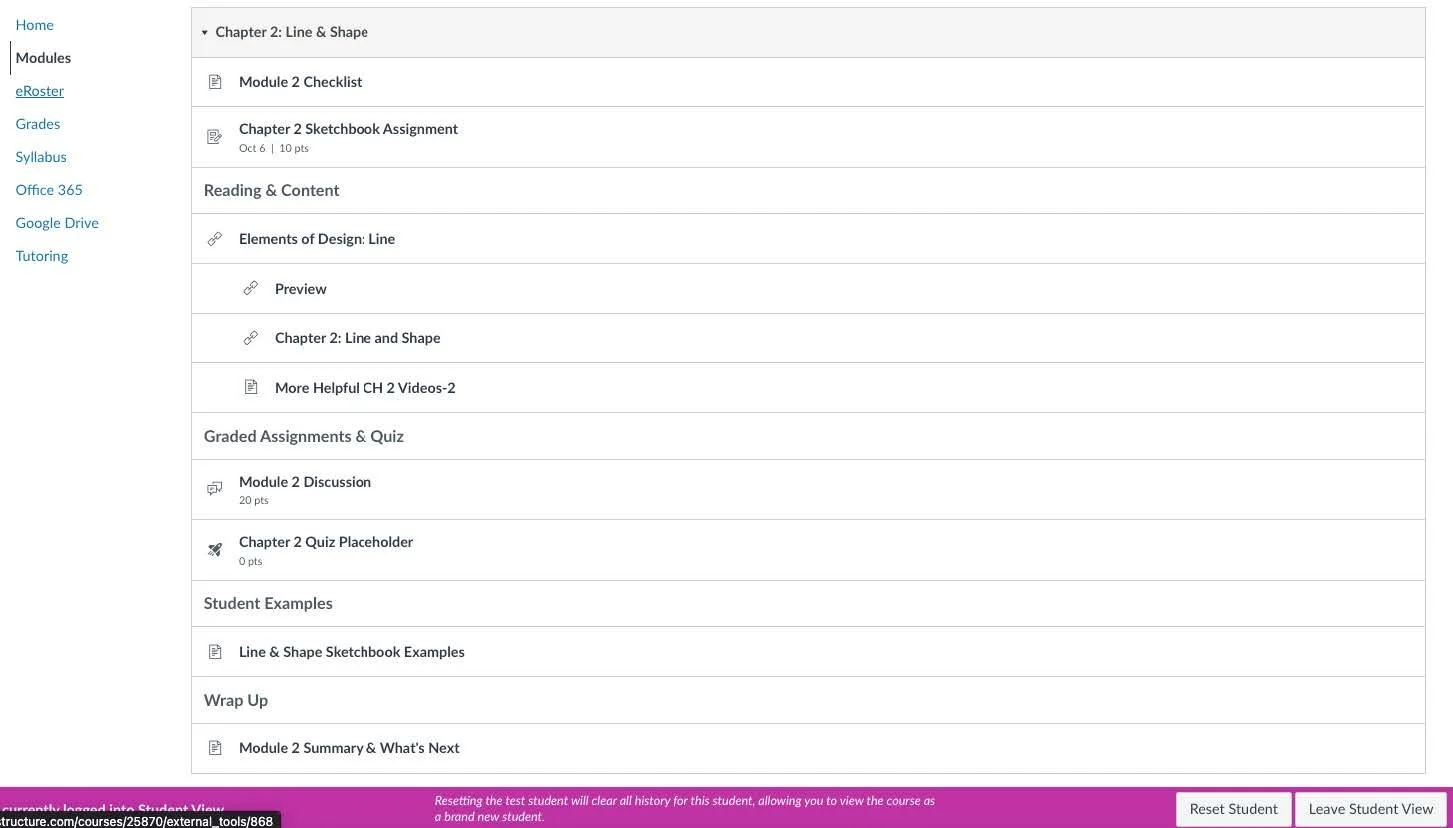
The following screenshot is a typical layout of a module designed in Canvas. As I have included screenshots of various assignments throughout this document, I will include screenshots of “Module 2 Checklist” and the “Module 2 Summary and What’s Next”.
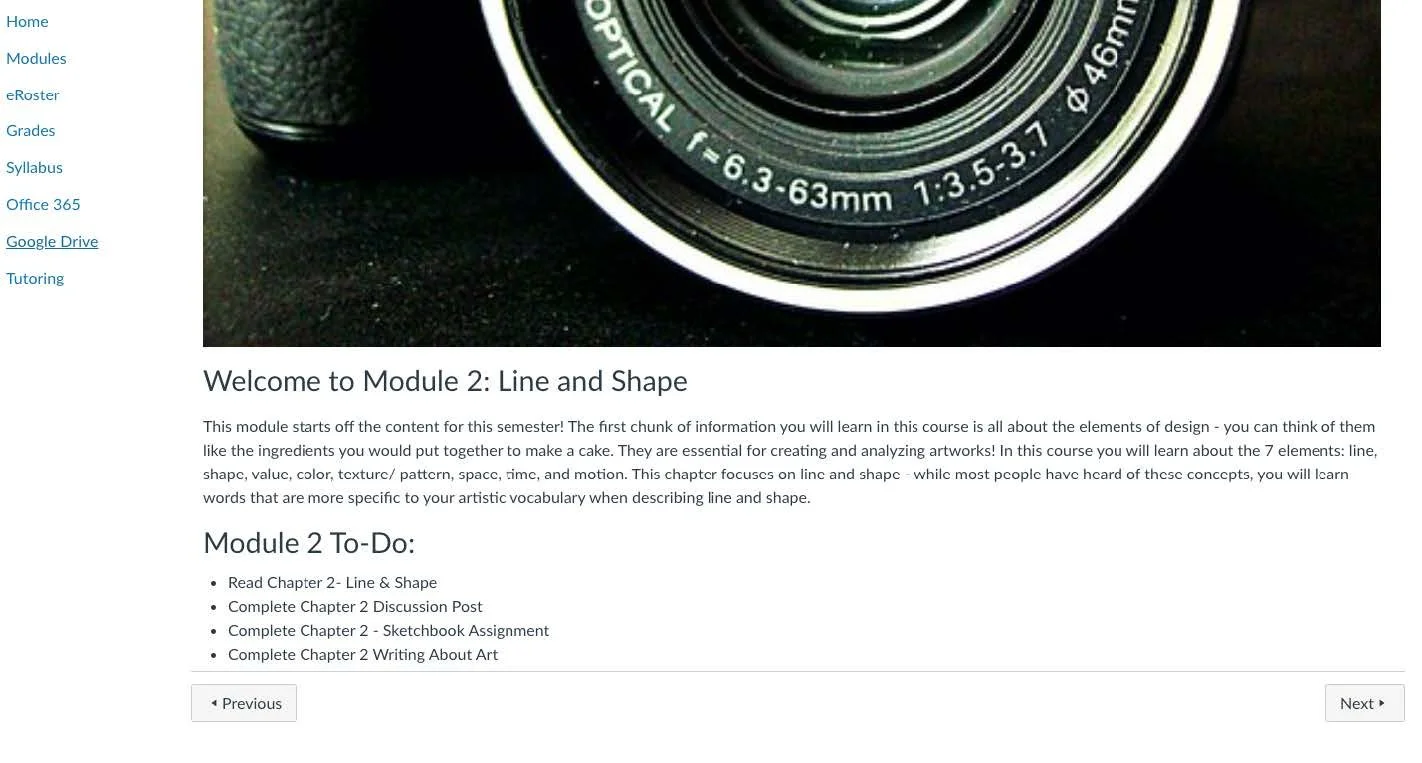
Each module has an introduction to the content and activities in the module. I also create a playlist/ list of assignments the student is responsible for in the module.
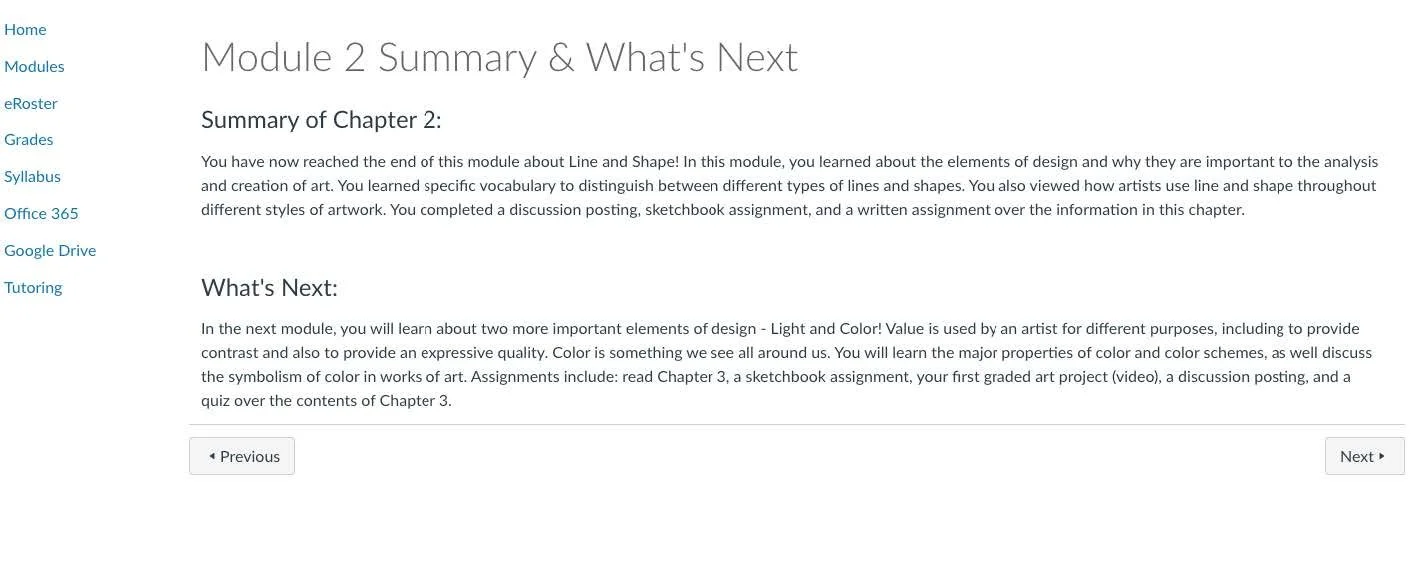
At the conclusion of each module, I summarized the content and activities in the module. I also briefly explained what the students will learn and uncover in the next module of the course!

Example #1 Canvas Layout: Project – Based Learning Assignment & Rubric Individual and/or Group TikTok Video Audience: Freshman and Sophomore students enrolled in art appreciation, primarily non majors. Project Objectives: 1. Using a smartphone or video recording device, create an educational video to educate viewers about the elements of design. 2. Learn and explain specific vocabulary as it relates to the elements of design. 3. Identify how the elements of design are used in artwork and in everyday life.

Rubric created in Canvas used to grade TikTok assignment.
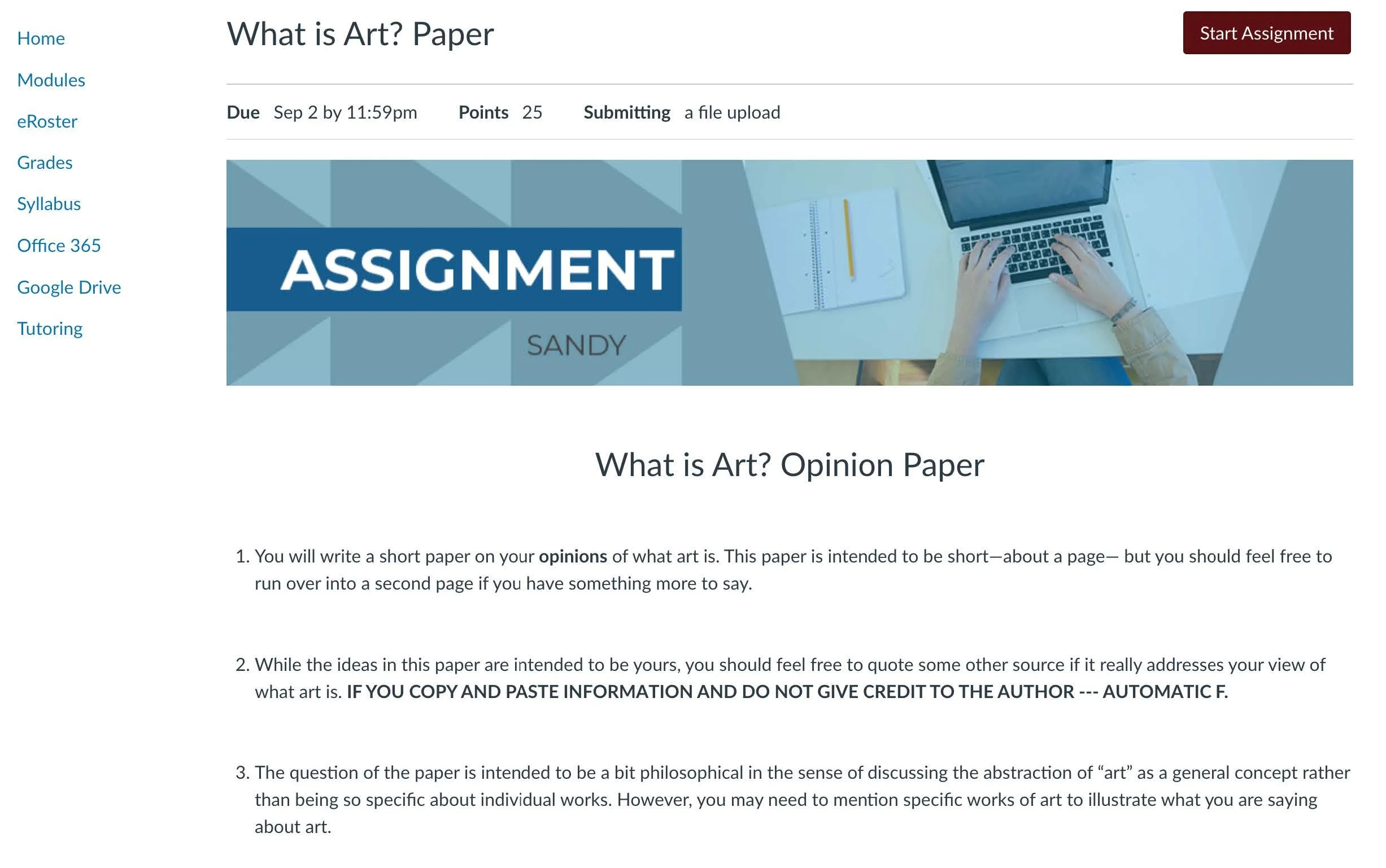
Example #2 Canvas Layout: Project – Inquiry-Based Opinion Paper Audience: Freshman and Sophomore students enrolled in art appreciation, primarily non-majors. Paper Prompt: You will write a short paper on your opinions of what art is. This paper is intended to be short—about a page— but you should feel free to run over into a second page if you have something more to say.

Rubric created in Canvas for What is Art? Paper

Example #3 Canvas Layout: Reflection Prompt (Open-ended Discussion) Discussion Prompt: For this particular discussion posting, you will think about the way contemporary art has changed since the year you were born until the year you turned 16. Of course, the field of art continues to change at a rapid pace!

Rubric created in Canvas for Discussions